Tuesday, 26 August 2014

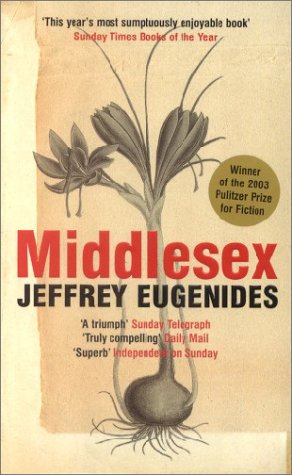
Middlesex ~ Jeffrey Eugenides

Not content with the emotional impact, nor the anatomical insight, contained in a diary written by an intersex convent girl in the 19th Century Jeffrey Eugenides decided to write a novel instead that would satisfy the reader's inquiring mind.

Middlesex is loosely based on the author's life and his own Greek heritage, however, Calliope/Cal (the protagonist) is his own creation and therefore the novel is not autobiographical.

I loved this book!!  Not only does it explore the themes of nature vs nurture, rebirth and the impact of a recessive gene on three generations of one family, but it also chronicles the life of two immigrant silkworm farmers from their isolated hillside home in Greece to their new life in prohibition era Detroit.

Calliope, their grand-daughter is born a hermaphrodite, however this is not discovered until she/he reaches puberty.  Told retrospectively, and commencing from the womb, Calliope takes us back to when her grandparents were young and how the recessive gene which is quite often found in isolated in-bred groups of people begins to rear its ugly head.

Really, this novel could have been distasteful however we are introduced to a wonderful group of characters with great personalities and eccentricities trying to make a success of their life in a new country, not knowing that their life choices are taking them down a road that will cause the teenage Calliope untold anguish.  Calliope suffers from the usual female teenage angst..... when will her period start?  Why is she so flat chested when her classmates are developing?  Why does she have a crush on her best friend?  Being of Greek heritage other tell tale signs are missed as she grows older .... the unwanted hair on her upper lip that needs waxing, the husky voice and the beginning of heavy set features.  I truly felt for Calliope as she brought back memories of my own insecurities as an introverted teenager.


One thing I didn't get was why Calliope's brother was called Chapter Eleven.  All the way through the novel I was hoping it would reveal itself.  It does actually, but very subtly and being Australian I didn't pick up on it.  American's would get it.  I won't spoil it here, read the book and if you are still in the dark you can Google Eugenides' answer.  It's quite clever.

Read by Maxine

Friday, 15 August 2014

The House of Mirth ~ Edith Wharton

Whilst Jane Austen used her knowledge of drawing room conversions as inspiration for her novels, Edith Wharton has drawn upon her experiences as a member of New York’s Upper Class Society for her novel The House of Mirth.

This book was wonderfully written, with the conversations between each character feeling completely natural.  Wharton shows the fabulously wealthy as being conceited, shallow and condescending, where their only good advice is to make sure that you ‘marry money’, where ‘breaking in new people’ is tiresome and where the most laborious job of the year is going through your furs.

Lily Bart, the novel’s protagonist, is a popular and beautiful member of New York’s Upper Class Society around 1890.  She has no money of her own and her parents are deceased, but her Aunt takes her in and as she is very wealthy she makes sure that Lily has the best clothes to wear for any occasion. Lily’s mother and her Aunt have groomed her to be a beautiful ornament, but whose arm she is to hang off remains to be seen.  At 29 years old she is under pressure to marry, but she cannot make up her mind.  She loves Lawrence Selden but she would be stepping down in the world if she made that match, and he definitely could not afford her extravagances.  Percy Gryce is fabulously wealthy but he’s a mother’s boy and Lily’s smoking and mounting gambling debts scare him off.  Simon Rosedale, a Jewish suitor is distasteful to her, but he begins to be her only option as time goes on.

Whilst she ponders her future, Lily finds herself in more than one compromising situation; although totally innocent on her part they spark malicious gossip about her that will not go away.  When she is accused of trying to steal away the husband of one of her friends, Bertha Dorset, whilst holidaying on the Dorset’s yacht the scandal ruins Lily’s status.  Lilly is innocent of course, but Bertha is trying to deflect possible gossip about her own indiscretions with a poet.

As the rumours circle round Lily’s Aunt is appalled by her apparent behaviour and in the final weeks before her death she disinherits Lily leaving her only a small legacy which will just cover a debt which is hanging over Lily’s head like a black cloud. The payment of the legacy is withheld for almost a year until legal problems with the Will are ironed out, and Lily is forced to find work.  Having been groomed for nothing but ornamentation Lily’s work output is poor, she is let go and her health and state of mind begin to suffer.

No longer needing to aim so high for social standing, Lawrence Selden is once again a possible match, but fate will see to it that they can never be together.

What a tragic figure Lily Bart is, and this novel highlights once again how social conventions of the time make life extremely difficult for young single women.  Thomas Hardy shows us time and again with his novels, and now we see that it cannot be escaped even with the wealthy.

As for the title, it comes from Ecclesiastes 7:4: “The heart of the wise is in the house of mourning; but the heart of fools is in the house of mirth”.

A great read.

Maxine 

Friday, 1 August 2014

Far From the Madding Crowd ~ Thomas Hardy

Bathsheba Everdene is a strong spirited girl, and whilst she thinks she knows her own mind she has not a clue with regards to the workings of a man’s mind.

Farmer Boldwood is a confirmed bachelor and even the beauty of Miss Everdene can’t turn his head at market. Bathsheba’s maid points out Boldwood’s indifference to her so, out of fun or maybe girlish spite, she sends him a Valentine Card sealed with a stamp marked ‘Marry Me’. 

This frivolous throw away moment changes everything. 

Boldwood becomes a man desperate to possess her, and presses her for her promise to marry to the point of breaking her spirit. Bathsheba had already turned down a proposal of marriage from the kindly Shepherd Oak when she first arrived in Weatherbury and Oak’s status looked like it was improving but, as her own situation improves by taking on her late Uncle’s farm, Bathsheba is in no hurry to lose her independence.  Unfortunately, during her unwanted courtship with Boldwood, she is dazzled by a rake (Sergeant Troy), who has already ruined one young woman, and the chance of future happiness begins to unravel for all.

Through this emotional drama Shepherd Oak remains a staunch and loyal friend, putting aside his own feelings to manage Bathsheba’s farm and trying to morally guide her.  In a time when propriety means everything, he has to withstand gossip from the neighbourhood which insinuates that he’s just hanging around Bathsheba and ‘biding his time’.

Set in Wessex, I loved the country setting and also the minor characters that work the farm.  Their dialogue and actions hark back to simpler times which consisted of manual labour, cider and gossip.

This novel highlights the fickleness of young women in matters of love. In an era when a promise is a promise, and solemnly binding, there’s no room for mistaken feelings. I’m not usually sentimental but Bathsheba’s realisation of Oak’s true friendship towards the end of the novel, and Oak’s realisation of his one dream, had me fighting back tears.

As for the title of the novel, it was taken from the following:

Far From the madding crowd's ignoble strife
Their sober wishes never learn'd to stray;
Along the cool sequester'd vale of life
They kept the noiseless tenor of their way.
                                  Elegy Written in a Country Churchyard by Thomas Gray


Throw away your bodice rippers, and read a love story with real class!

Read by Maxine

Monday, 7 July 2014

Dying Embers ~ M R Cosby

This is the first time that I have waited in anticipation for the release of a book by an independent author. Knowing that the style was inspired by one of my favourite writers, Robert Aickman, I was very keen to read it.

Aickman has the ability to unsettle your nerves when writing about everyday events that at first appear normal then go slightly off kilter.  I can honestly say that I wasn’t disappointed. These short stories are very well constructed, and the unsettling nature of each varies in degrees as does the strangeness.

Abraham’s Bosom was one of my favourite stories as it brought to mind how I felt on my recent visit to Rangitoto Island.  My partner and I had walked off the beaten track looking for lava caves and I became increasingly alarmed when I couldn't hear any of the other trekkers and was unable to orient myself to where we should be on our map.  This story of a jogger becoming separated from his running mate and experiencing a supernatural event reminded me not only of Robert Aickman but also of Alfred Noyes’ Midnight Express by the last passage.

Building Bridges I found to be a nice cloying story about a father wanting to reconnect with his family however forces move against him during a visit to a museum exhibit.

The Next Terrace is the perfect opening story and lays the foundation to what can be expected within following the pages and Playing Tag I thought was a beautifully written story which really evoked the grounds of an English stately home.

La Tarasque was probably my least favourite of the collection but mainly because I couldn't identify with any part of it, and I’m still trying to work out the title of the last story (Fingerprinting) although I did really enjoy the story itself.  I’m staying in some obscure small towns at the end of the year on my first ever Aussie road trip, so I shall bear this story in mind!

This whole collection has been put together very nicely; Some of the stories are very subtle whilst others grab at you, but what I liked most about these stories is that they are very identifiable as being Australian. 

Read by Maxine

Lime Street at Two ~ Helen Forrester

"In this book, Helen Forrester continues the moving story of her early life with an account of the war years in blitz-torn Liverpool, and the happiness which she so nearly captured, but which was to elude her twice. In 1940 Helen, now twenty, reeling from the news that her fiancé Harry has been killed on an Atlantic convoy, is working long hours at a welfare centre in Bootle, five miles from home. Her wages are pitifully low and her mother claims the whole lot of them for housekeeping. Then, early in 1941, she gets a new job and begins to enjoy herself a little. But in May the bombing starts again and another move brings more trouble to Helen, trouble which will be faced, as ever, with courage and determination."

I found this series of books very interesting and provided a pretty vivid description of the poverty in England during the period between the world wars.  However I found it pretty depressing to think this mother could behave in such a selfish manner to her children. Many of the other books I have read for this era contained as much poverty if not more so but none with parents who over many years just never made any improvements and used their children so harshly.

Helen Forrester (1919 – 2011) is an English-born author famous for her books about her early childhood in Liverpool during the Great Depression as well as several works of fiction. 


Read by Robyn S.

By the Waters of Liverpool ~ Helen Forrester

“The third volume in the classic story of Helen Forrester's childhood and adolescence in poverty-stricken Liverpool during the 1930s.

Helen has managed to achieve a small measure of independence. At seventeen, she has fought and won two bitter battles with her parents, the first for the right to educate herself at evening classes, the second for the right to go out to work. Her parents are still as financially irresponsible as ever, wasting money while their children lack blankets, let alone proper beds, but for Helen the future is brightening as she begins to make friends her own age and to develop some social life outside the home. At twenty, still never kissed by a lover, Helen meets Harry, a strong, tall seaman, and falls in love.”

Review from the internet

Read by Robyn S.

Liverpool Miss ~ Helen Forrester

“The second volume of Helen Forrester's powerful, painful and ultimately uplifting four-volume autobiography of her poverty-stricken childhood in Liverpool during the Depression. The Forrester family are slowly winning their fight for survival. But fourteen-year-old Helen's personal battle is to persuade her parents to allow her to earn her own living, to lead her own life after the years of neglect and inadequate schooling while she cared for her six younger brothers and sisters. Her untiring struggles against illness caused by severe malnutrition and dirt (she has her first bath in four years) and, above all, the selfish demands of her parents, make this a story of amazing courage and perseverance.”

Review from the internet, Read by Robyn S.