Friday, 24 October 2014

The King's Curse ~ Philippa Gregory

"The final novel in the Cousins' War series, the basis for the critically acclaimed Starz miniseries, The White Queen, by #1 New York Times bestselling author and "the queen of royal fiction" (USA TODAY) Philippa Gregory tells the fascinating story of Margaret Pole, cousin to the "White Princess," Elizabeth of York, and lady-in-waiting to Katherine of Aragon.

Regarded as yet another threat to the volatile King Henry VII's claim to the throne, Margaret Pole, cousin to Elizabeth of York (known as the White Princess) and daughter of George, Duke of Clarence, is married off to a steady and kind Lancaster supporter-Sir Richard Pole. For his loyalty, Sir Richard is entrusted with the governorship of Wales, but Margaret's contented daily life is changed forever with the arrival of Arthur, the young Prince of Wales, and his beautiful bride, Katherine of Aragon. Margaret soon becomes a trusted advisor and friend to the honeymooning couple, hiding her own royal connections in service to the Tudors.

After the sudden death of Prince Arthur, Katherine leaves for London a widow, and fulfills her deathbed promise to her husband by marrying his brother, Henry VIII. Margaret's world is turned upside down by the surprising summons to court, where she becomes the chief lady-in-waiting to Queen Katherine. But this charmed life of the wealthiest and "holiest" woman in England lasts only until the rise of Anne Boleyn, and the dramatic deterioration of the Tudor court. Margaret has to choose whether her allegiance is to the increasingly tyrannical king, or to her beloved queen; to the religion she loves or the theology which serves the new masters. Caught between the old world and the new, Margaret Pole has to find her own way as she carries the knowledge of an old curse on all the Tudors."

Loved it what can I say!

Review from the internet.

Read by Robyn S.

Love in a Cold Climate ~ Nancy Mitford

"One of Nancy Mitford's most beloved novels, Love in a Cold Climate is a sparkling romantic comedy that vividly evokes the lost glamour of aristocratic life in England between the wars.

Polly Hampton has long been groomed for the perfect marriage by her mother, the fearsome and ambitious Lady Montdore. But Polly, with her stunning good looks and impeccable connections, is bored by the monotony of her glittering debut season in London. Having just come from India, where her father served as Viceroy, she claims to have hoped that society in a colder climate would be less obsessed with love affairs. 

The apparently aloof and indifferent Polly has a long-held secret, however, one that leads to the shattering of her mother's dreams and her own disinheritance. When an elderly duke begins pursuing the disgraced Polly and a callow potential heir curries favor with her parents, nothing goes as expected, but in the end all find happiness in their own unconventional ways".

Review from the Internet
Read by Robyn S.

The Pursuit of Love ~ Nancy Mitford

"Few aristocratic English families of the twentieth century enjoyed the glamorous notoriety of the infamous Mitford sisters. Nancy Mitford's most famous novel, The Pursuit of Love satirizes British aristocracy in the twenties and thirties through the amorous adventures of the Radletts, an exuberantly unconventional family closely modeled on Mitford's own.

The Radletts of Alconleigh occupy the heights of genteel eccentricity, from terrifying Lord Alconleigh (who, like Mitford's father, used to hunt his children with bloodhounds when foxes were not available), to his gentle wife, Sadie, their wayward daughter Linda, and the other six lively Radlett children. Mitford's wickedly funny prose follows these characters through misguided marriages and dramatic love affairs, as the shadow of World War II begins to close in on their rapidly vanishing world.  Based on her real life with names changed to protect the innocent."

Review from the Internet
Read by Robyn S

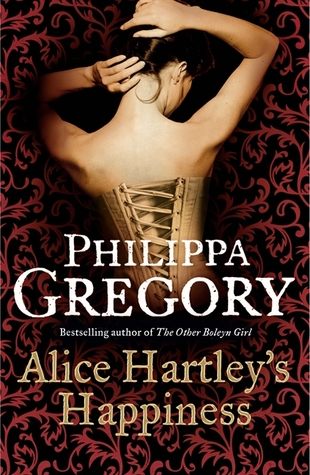
Alice Hartley's Happiness ~ Phillipa Gregory


When Professor Charles Pringle does not react to his wife`s special birthday dance of the seven veils, Alice decides to leave him and moves in with an unsuspecting student, Michael. His aunt dies and leaves him her house, so the couple move in and convert it into a "growth centre".  


Funny little story it appears that it may have been produced under different names later on.

Read by Robyn S.

Tuesday, 26 August 2014

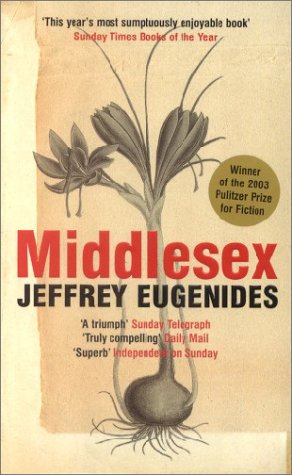
Middlesex ~ Jeffrey Eugenides

Not content with the emotional impact, nor the anatomical insight, contained in a diary written by an intersex convent girl in the 19th Century Jeffrey Eugenides decided to write a novel instead that would satisfy the reader's inquiring mind.

Middlesex is loosely based on the author's life and his own Greek heritage, however, Calliope/Cal (the protagonist) is his own creation and therefore the novel is not autobiographical.

I loved this book!!  Not only does it explore the themes of nature vs nurture, rebirth and the impact of a recessive gene on three generations of one family, but it also chronicles the life of two immigrant silkworm farmers from their isolated hillside home in Greece to their new life in prohibition era Detroit.

Calliope, their grand-daughter is born a hermaphrodite, however this is not discovered until she/he reaches puberty.  Told retrospectively, and commencing from the womb, Calliope takes us back to when her grandparents were young and how the recessive gene which is quite often found in isolated in-bred groups of people begins to rear its ugly head.

Really, this novel could have been distasteful however we are introduced to a wonderful group of characters with great personalities and eccentricities trying to make a success of their life in a new country, not knowing that their life choices are taking them down a road that will cause the teenage Calliope untold anguish.  Calliope suffers from the usual female teenage angst..... when will her period start?  Why is she so flat chested when her classmates are developing?  Why does she have a crush on her best friend?  Being of Greek heritage other tell tale signs are missed as she grows older .... the unwanted hair on her upper lip that needs waxing, the husky voice and the beginning of heavy set features.  I truly felt for Calliope as she brought back memories of my own insecurities as an introverted teenager.


One thing I didn't get was why Calliope's brother was called Chapter Eleven.  All the way through the novel I was hoping it would reveal itself.  It does actually, but very subtly and being Australian I didn't pick up on it.  American's would get it.  I won't spoil it here, read the book and if you are still in the dark you can Google Eugenides' answer.  It's quite clever.

Read by Maxine

Friday, 15 August 2014

The House of Mirth ~ Edith Wharton

Whilst Jane Austen used her knowledge of drawing room conversions as inspiration for her novels, Edith Wharton has drawn upon her experiences as a member of New York’s Upper Class Society for her novel The House of Mirth.

This book was wonderfully written, with the conversations between each character feeling completely natural.  Wharton shows the fabulously wealthy as being conceited, shallow and condescending, where their only good advice is to make sure that you ‘marry money’, where ‘breaking in new people’ is tiresome and where the most laborious job of the year is going through your furs.

Lily Bart, the novel’s protagonist, is a popular and beautiful member of New York’s Upper Class Society around 1890.  She has no money of her own and her parents are deceased, but her Aunt takes her in and as she is very wealthy she makes sure that Lily has the best clothes to wear for any occasion. Lily’s mother and her Aunt have groomed her to be a beautiful ornament, but whose arm she is to hang off remains to be seen.  At 29 years old she is under pressure to marry, but she cannot make up her mind.  She loves Lawrence Selden but she would be stepping down in the world if she made that match, and he definitely could not afford her extravagances.  Percy Gryce is fabulously wealthy but he’s a mother’s boy and Lily’s smoking and mounting gambling debts scare him off.  Simon Rosedale, a Jewish suitor is distasteful to her, but he begins to be her only option as time goes on.

Whilst she ponders her future, Lily finds herself in more than one compromising situation; although totally innocent on her part they spark malicious gossip about her that will not go away.  When she is accused of trying to steal away the husband of one of her friends, Bertha Dorset, whilst holidaying on the Dorset’s yacht the scandal ruins Lily’s status.  Lilly is innocent of course, but Bertha is trying to deflect possible gossip about her own indiscretions with a poet.

As the rumours circle round Lily’s Aunt is appalled by her apparent behaviour and in the final weeks before her death she disinherits Lily leaving her only a small legacy which will just cover a debt which is hanging over Lily’s head like a black cloud. The payment of the legacy is withheld for almost a year until legal problems with the Will are ironed out, and Lily is forced to find work.  Having been groomed for nothing but ornamentation Lily’s work output is poor, she is let go and her health and state of mind begin to suffer.

No longer needing to aim so high for social standing, Lawrence Selden is once again a possible match, but fate will see to it that they can never be together.

What a tragic figure Lily Bart is, and this novel highlights once again how social conventions of the time make life extremely difficult for young single women.  Thomas Hardy shows us time and again with his novels, and now we see that it cannot be escaped even with the wealthy.

As for the title, it comes from Ecclesiastes 7:4: “The heart of the wise is in the house of mourning; but the heart of fools is in the house of mirth”.

A great read.

Maxine 

Friday, 1 August 2014

Far From the Madding Crowd ~ Thomas Hardy

Bathsheba Everdene is a strong spirited girl, and whilst she thinks she knows her own mind she has not a clue with regards to the workings of a man’s mind.

Farmer Boldwood is a confirmed bachelor and even the beauty of Miss Everdene can’t turn his head at market. Bathsheba’s maid points out Boldwood’s indifference to her so, out of fun or maybe girlish spite, she sends him a Valentine Card sealed with a stamp marked ‘Marry Me’. 

This frivolous throw away moment changes everything. 

Boldwood becomes a man desperate to possess her, and presses her for her promise to marry to the point of breaking her spirit. Bathsheba had already turned down a proposal of marriage from the kindly Shepherd Oak when she first arrived in Weatherbury and Oak’s status looked like it was improving but, as her own situation improves by taking on her late Uncle’s farm, Bathsheba is in no hurry to lose her independence.  Unfortunately, during her unwanted courtship with Boldwood, she is dazzled by a rake (Sergeant Troy), who has already ruined one young woman, and the chance of future happiness begins to unravel for all.

Through this emotional drama Shepherd Oak remains a staunch and loyal friend, putting aside his own feelings to manage Bathsheba’s farm and trying to morally guide her.  In a time when propriety means everything, he has to withstand gossip from the neighbourhood which insinuates that he’s just hanging around Bathsheba and ‘biding his time’.

Set in Wessex, I loved the country setting and also the minor characters that work the farm.  Their dialogue and actions hark back to simpler times which consisted of manual labour, cider and gossip.

This novel highlights the fickleness of young women in matters of love. In an era when a promise is a promise, and solemnly binding, there’s no room for mistaken feelings. I’m not usually sentimental but Bathsheba’s realisation of Oak’s true friendship towards the end of the novel, and Oak’s realisation of his one dream, had me fighting back tears.

As for the title of the novel, it was taken from the following:

Far From the madding crowd's ignoble strife
Their sober wishes never learn'd to stray;
Along the cool sequester'd vale of life
They kept the noiseless tenor of their way.
                                  Elegy Written in a Country Churchyard by Thomas Gray


Throw away your bodice rippers, and read a love story with real class!

Read by Maxine