Tuesday, 22 January 2013

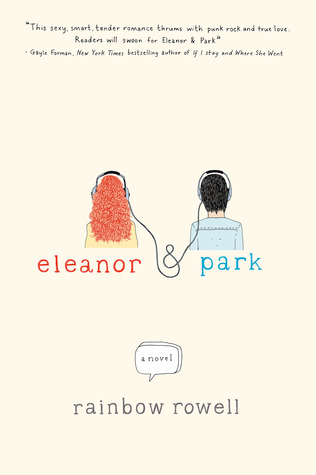
Eleanor and Park by Rainbow Rowell

Because you never forget your first love.

Set over the course of one school year in 1986, ‘Eleanor and Park’ is the story of two star-crossed misfits – smart enough to know that first love almost never lasts, but brave and desperate enough to try.  

Park is the only Korean boy (as far as he knows) in the entire of Omaha. He skates just on the edge of freakdom by an unexpected friendship (sort of) with the captain of the football team. Eleanor just doesn’t fit in – she’s big, red-headed, ungainly and lives in a house of horrors with her mother, feral stepfather and three siblings. Banished from home for a year because her stepfather can’t stand her, she’s come home and started at a new school. No-one talks to her, the mean girls steal her clothes during gym and flush them down the toilet and no-one wants to let her sit next to them on the bus..until Park relents and moves over by the window to let her sit down. In the course of the school year, they slowly discover a mutual love for comic books and music – and eventually, each other.  

Park’s family are absolutely set against Eleanor, she’s just not what his petite, plain-speaking Korean mother wants for her eldest son. Eleanor just can’t tell her family anything about it. Her stepfather rules with a rod (and fists) of iron and Eleanor knows that if he finds out that anyone is doing anything nice for her, he’s likely to beat her or worse – send her away again.  

This is a great story. It recreates the mid-80s perfectly, with the music, movies, fashion and language and paints a very, very realistic and engaging story about two unlikely lovers and the way that teenage love is sometimes all you need – but is sometimes also just more than you can cope with.
 
Di

Across The Universe by Beth Revis


Seventeen year old Amy joins her parents on a inter-galactical colonisation mission to Alpha Centauri. While her parents are essential to the future of the colony, Amy is listed in the manifest as ‘non-essential cargo’. Cryogenically frozen (and the book goes into quite uncomfortably detailed descriptions about what this might feel like), the colonists are loaded aboard ‘Godspeed’ for the 300-year voyage, with the spaceship manned by workers who, over the generations, will tend the vessel and the precious cargo.

Amy begins to awaken. Are we there yet? Embedded in her cryogenic soup, she begins to drown, but is rescued by a quick-thinking worker. But Amy’s journey is just beginning. Someone is unplugging the colonists and allowing them to die. Fifty years before the voyage is due to end, Amy finds herself stranded alone in a world that has long forgotten her and everyone and everything that she remembers – with a murderer on board. It is utterly chilling.  

Revis portrays the claustrophobic and incestuous atmosphere aboard ‘Godspeed’ extremely well and the desperation of Amy in trying to adjust to her new life. There is no grass, only something that looks like it. There is no sun, only a bright light that sort of looks a bit sunnish but not really. The food looks familiar but doesn’t taste the same. The animals look like animals back on Earth, but don’t behave like them. She wants nothing more than to unplug her parents and to have someone or something familiar to clutch hold of – but her parents are vital to the future of the colony and she needs to protect them against whoever is killing the space travellers.  

Of course, it’s also a love story. Each generation (bred at precise intervals and injected with DNA-enhancing genes to overcome the dangers of inbreeding) has a leader – Elder. Amy is so different – among an entire spaceship of people who look the same, she alone has pale skin and ‘sunset hair’. She’s a freak and is shunned, but Elder is entranced. With the help of rebels on board, Amy and Elder defy the dangerously omnipotent hierarchy to discover the secrets aboard the ‘Godspeed’ – who is killing the colonists and why, and why isn’t the ship getting any closer to its final destination.  

This is a book written for teens, but very entertaining and suspenseful. Revis creates a very realistic picture of life aboard the ship and the secrets and dangers that must be overcome.
 
Di

Tuesday, 15 January 2013

The Brilliant Women Collection by Eve Merrier


I thoroughly enjoyed reading this quirky little book by Eve Merrier.  This is a personal collection of those women who have inspired the author along with some simple facts and figures relating to the disparity between men and women in the working arena, along with a nice injection of humour in the commentary.  Eve's role models "don’t stand behind anyone: they are next to their partners as equals or they are way out ahead, showing them how it’s done.”

Those inspiring women through the ages include activists, inventors and philosophers along with well known figures such as Michelle Obama, Hillary Clinton and our very own Julia Gillard (whose popularity certainly increased after 'that speech' fired at the opposition leader Tony Abbott).

I must admit that I had not heard of many of the women within this collection, but it was certainly interesting to see how hard it has been, how far we have come and how far we have yet to go.  It got me thinking of the women who I find inspiring and amongst them I found my own sister who has battled for recognition within her field of research at an English University and who was constantly passed over for promotion in favour of (less qualified?) males.  She never gave up though and has since received the recognition she deserves.

This book could have had a heavy feminist tone, but it does not.  It is simply a celebration of those unselfish women who have forged ahead in their chosen field and raised awareness of women's issues in the process.  The consistent message in this book is: 'be yourself' and 'never give up'. 

A nice inspiring read.

Maxine

Friday, 7 December 2012

The Brothers Karamazov ~ Fyodor Dostoevsky


The Brothers Karamazov is the story of three brothers, two women, a grotesque father, an illegitimate brother and three thousand rubles, set in a provincial town in Russia in the 1860's. 

Dimitri Karamazov was my favourite of the brothers.  He is a 'scoundrel' by his own admission and whilst he has a good, if not passionate heart, he has a temper which prevents him from doing what is right.

Alexei (Alyosha) Karamazov is the type of character I find annoying.  He is too 'good' and kind, (like a benevolent Dickens character, just a bit too good to be true) but I read that Dostoevsky had lost his 3 year old son Alyosha to epilepsy, and so he imbued Alexei with the qualities he admired and, I guess, would have wished his son to have aspired to had he lived.  The author's grief at the loss of his son is also reflected in the novel with the death of a young character, whose funeral scene I will never forget.

I felt I didn't really get to know Ivan Karamazov very well, he is the serious brother who adores the youngest (Alexei) but he carries the Karamazov chip on his shoulder for all to see.

This is one mammoth read, and I did at times feel bored with some of the philosophical passages and long speeches, and I was a bit baffled by The Grand Inquisitor until I read it a couple of times and could appreciate and agree with what Ivan was saying.  But, if you can get past the religion and philosophy this is an exciting story of lust, passion, greed and murder.

I must mention too, the characterisation of the brother's father Fyodor is wonderful.  He is a middle aged wealthy pig.  He is a lustful, disgusting and rude drunk who actually made me laugh in most of his scenes.  He is so vile I loved him! ( I wonder what this says about me, I loved Fyodor but found Alexei annoying? Maybe I just appreciate well drawn antagonists?).

There is a sort of madness attributed to all the characters I have read so far by Dostoevsky, yet you can always identify with them and their self destructive natures.  This novel was planned to be part of a greater work but was sadly never realised as Dostoevsky died just four months after its publication.  I would love to have known what he had in store for Dimitri.

 Maxine


Thursday, 8 November 2012

The Return of the Soldier ~ Rebecca West


This very short novel is the story of an English soldier who is repatriated from the bloodlust of the French trenches during WWI because he has lost his short-term memory, presumably as a result of being ‘shell-shocked’ – the condition we now know as post-traumatic stress disorder.

Chris Baldry, handsome, personable and wealthy, is the soldier. His ‘madness’ took the form of returning his consciousness to the world he knew 15 years previously. Thus the army officials sent news of his illness to an old address instead of his current home, where his wife Kitty and cousin Jenny were only mildly concerned at not hearing from him for a fortnight.

Kitty’s careless snobbery is revealed when her housemaid announces the arrival of a woman who has news for them: condescending to speak to the stranger, Kitty reflects that her hair is ‘Last year’s fashion…but I fancy it’ll do for a person with that sort of address.’ The visitor, shabby and diffident in the affluent house, is Margaret Grey, bringing them the news that Chris is ill, not wounded but apparently confused because a War Office telegram and letter from Chris have been sent to an old address and he is begging to see Margaret, who reveals that she knew him 15 years previously. Kitty, scornful and certain the woman is trying somehow to get money from her, is rude and dismissive; Jenny however, senses the truth and is horrified by the insight into Kitty’s true nature.

When the story is confirmed and Chris is brought home, his loss of memory and complete lack of recognition of his wife, his alienation in the altered house, are excruciating to read. He does recognise Jenny, who of course he had known since childhood, and who senses the hopelessness of the situation for both disoriented husband and rejected wife. Chris is obsessed by only one thought-he must see Margaret. Kitty, brittle and suspicious with bewildered hurt, agrees to bring ‘that dowd’ to the house, noting bitterly that despite his amnesia, ‘He’s well enough to remember her all right’.

Thus Chris is reunited with Margaret, who had been the love of his life and a true kindred spirit. Far from being disillusioned by her age and the poverty wrought on her by sad circumstances, he is more in love with her than ever and they share the anguish of their parting over a petty quarrel all those years ago.

The story proceeds to unravel the true natures of all the characters involved, against the background of medical and psychological efforts to ‘cure’ Chris. Rather than war-induced amnesia, it gradually emerges that the cause may be more related to the social situation, including the death of Chris and Kitty’s infant son and Margaret’s life story.

On one level, this is a sadly familiar story of the effects of war; however, it seems to be a deeper examination of social mores and their imprisonment of individuals who defy the rules and want a different lifestyle. I was gripped from the start and read it in one night!

Author Rebecca West, born Cicily Isabel Fairfield in 1892, grew up with two sisters and their single mother, deserted by Cicily’s father at age 9. A hard struggle in those days, this background led her to be a feminist and Suffragette, and fierce political activist: she changed her name to Rebecca West to spare her family the social repercussions of her activism. She had a long affair with H.G. Wells, with whom she had a son.

I first became aware of her when, about to travel to Croatia, I read her massive history of Yugoslavia, ‘Black Lamb and Grey Falcon’, an amazingly comprehensive story of that country’s harsh past and dour culture.

HELEN          

The Dig Tree ~ Sarah Murgatroyd


Never has my imagination been so captivated reading a novel as it has been reading The Dig Tree.

Living in Australia I had of course heard of the names of Burke and Wills, I mean there is a Burke and Wills Hotel in Toowoomba!  I knew that they had been ill fated explorers in the 1800's but that was about it.

Finishing The Dig Tree today after hardly being able to put it down, I marvel at those early Europeans who risked their lives in pursuit of knowledge of Australia's interior.

The expedition lead by Burke, and his second Wills, was mismanaged from it's conception, to the returning of their bodies for burial.  Burke was only chosen because he happened to be a 'gentleman' (albeit an Irish one), and that was of prime importance for the Exploration Committee, it didn't matter that Burke couldn't even find his way home after a night at the pub.

Sarah Murgatroyd has written a very compelling story from start to finish, giving an incredible insight into what drove those men and how it all went horribly wrong.  When Burke and Wills left Melbourne, their supplies included an oak dining table and a bath tub!  Aboriginals they met along the way brought gifts of food, but the explorers deemed them a nuisance as they wanted gifts in return from their supplies - knives, oilcloth etc  On the return trip from the Gulf of Carpentaria Burke finally succeeded in scaring the natives off completely, and it was then that he and his remaining men realised the folly - they had to discard the supplies that could have been traded for food because they were too weak to carry them - and finally all but one starved to death surrounded by the bush food they did not know how to prepare properly.

Other explorers of the outback are mentioned in the novel too as this had been a race between the Australian colonies in the hope of opening up the interior for the Telegraph and claiming it for their own.  Names like the Stuart Highway, Leichhardt, Mitchell and Julia Creek all now have a special meaning to me, they will no longer be just the names of places where I freight our company's products.

This novel also gives you a reality check as to what the Europeans did to the Aboriginal tribes in Australia and how they suffered the loss of their native land to the white intruders.  You can't change the past but they were treated very badly indeed.

Coming from England I do feel the lack of real 'history' here compared to Europe, but having now read The Dig Tree I can appreciate that Australian's colonial history may only be recent, but it can be utterly fascinating.

Maxine

Tuesday, 30 October 2012

Travels With My Sister ~ Milan to Cortona


Planning the trip is part of the pleasure. For those of us who enjoy the choices and challenges of travelling independently, the internet is a godsend as long as you work to specific criteria, remember to convert foreign currency prices to Oz dollars, and watch the bottom line for assorted ‘city taxes’ and ‘booking charges’ before you present the plastic card. Another thing I’ve learned to check is the distance from airport to city; Milan’s main airport is a forty-five minute drive from the city, which translates to A$100 by taxi! However there is a very plush bus service for A$13 –if you are not too weary after the flight to find it.

My criteria are mainly location and price. Central location means higher price, generally speaking, but there are gems to be found in back streets – for our overnight stay in Milan on arrival in Italy, I found a small 2-star hotel just 2 blocks from La Scala and the Cathedral: small bedroom and a shower recess that was a challenge to tuck our bottoms in to close the door, but spotlessly clean, and with a delightful breakfast room with stained glass windows and very comprehensive breakfast included in the price.
 
The next day, onward by train to Cortona, via Florence; we had checked our timetable and bought tickets online, but nearly came undone in Florence where we had to change trains with fairly tight timing because Cortona doesn’t have many trains on Sundays – and found that tickets ain’t tickets, only vouchers that have to be processed at confusing machines on the very crowded station. So Sis did the processing while I wrestled our luggage towards the waiting train and sweated until she came running down the platform with a couple of minutes to spare! The trains are VERY punctual.
 
Our first sight of Cortona from the train was thrilling. High on a hill, the mellow old buildings appeared to be painted on the patchwork green and brownish landscape, a quintessential Tuscan portrait. We were driven to our apartment by the owner’s English-speaking friend (a real bonus) and I was torn between loving the scenery and worrying about the quality of the apartment I’d booked online – it’s one thing to live with my own decisions, but another to feel responsible for Sis – what if I’d booked a real lemon?

The owner and a crowd of curious neighbours were there to give us a warm and confused Italian welcome, and as soon as we made it inside my worries were dissolved in the huge grins of delight on our faces – it was magic! Old, 2-storey stone, with 2 bathrooms, bedrooms beautifully prepared with ironed, embroidered linen, fully equipped kitchen and lounge furnished with antiques, shuttered windows framing the view of Tuscan farmland. First impressions? We were speechless.


Sampling Cortona’s local produce

Ensuite bathroom, Italian style


We couldn’t wait to get out and explore the town, which is small and easy to navigate; well, as long as you can push your legs and lungs up and down the steep streets and winding laneways! Shopping for fresh food was a delight, and we were like a couple of kids playing house, so delighted to have our own little pad to cook snacks in and just live to our own timetable instead of being in a hotel.


The view from my bedroom!

 
So we settled in for 2 weeks, and spent our days walking, eating, drinking, shopping, exploring. We found the sanctuary where St. Francis went for retreats, a massive stone building where there are still monks spending retreat time gardening and maintaining the place – one of them chatted to us and found me an English version of the history of the Sanctuary.

We hired a car for a few days to explore the countryside; I was promptly and undemocratically appointed driver so had to take the challenge of left-hand driving amongst some of the craziest drivers on the planet. All went well until we drove on to the ferry to go to Elba: the attendant beckoned me to one side and directed me to drive up the 45 deg. ramp to the upper deck for tiny cars, and I swear the ramp was no wider than my dining table- I was paralysed for a moment, just can’t do this, help! But the cars behind me had no mercy and nor did the attendant, who ran up the ramp backwards in front of me, urging me on – did he not realise he was in imminent danger of being crushed as I was terrified of losing revs and stalling on the bloody ramp! Terrifying.

We survived, and loved exploring Elba with its history as the place where “The Emperor Napoleon took early retirement”(Lonely Planet quote). His house and garden were open to tour, and well maintained, decorated with horses’ head sculptures (he missed his battle ponies) and pictures of bees (apparently the royal symbol of his court – who knew?). Some wonderful trompe de l’oeil wall painting of drapes that looked so real you wanted to touch them. Apparently the man basically ran the island and lined his pockets with local industry, and then escaped in plain sight while the English administrator was away for a week!
 
Evening in the piazza
Most days, we just enjoyed being temporary locals in our village; we felt disgracefully superior towards the bus tour groups who were dropped off for a few hours and martialled together by flag-carriers while we sipped and munched in our favourite cafes! In the evenings we watched the locals gather and chat, the women strolling with children while the old men gathered in their corner of the piazza where they seemed to have exclusive use of the seats to argue loudly, gesticulate, and drink beer.

Cortona - the house used as a set for‘Under the Tuscan Sun’


There were a couple of typically Italian adventures, such as the day we took the bus to a nearby town for an annual market, then waited over an hour for the bus home – only to be told (eventually) that on this market day, buses don’t run from this stop! No notices, just cancel the buses! Local knowledge takes a little longer to pick up, and you can get frustrated, or just laugh at yourself and walk to the other side of town to catch the bus – that’s independent travel.

Helen