Wednesday, 13 February 2013

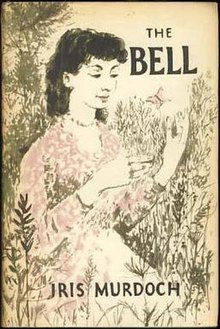
The Bell ~ Iris Murdoch


This is my third Iris Murdoch read.  I thoroughly enjoyed the satirical A Severed Head and the hilarious The Sea, The Sea, so when I picked up The Bell and read the blurb I was expecting a comedy of sorts set in a religious community.  What I got, however, was a totally different kind of read with The Bell being more about dysfunctional people, flawed relationships and torn emotions. 

The novel is set in Gloucestershire at Imber Abbey, where a small lay Anglican community live and work simply.  The story opens with Dora Greenfield, a wayward mischievous woman who is returning to her marriage after an affair.  Dora’s husband Paul, an older man, loves her but no longer respects her and though she is frightened of him and his bullying ways she is more afraid of him when they are apart.  Paul is conducting research at Imber Abbey and when Dora arrives she feels like a fish out of water as whatever she does seems to contradict with what the community is about.

The novel then switches focus to the head of the community, and owner of the Imber Community house, Michael Meade.  Originally a teacher, he once had dreams of becoming a priest but these were destroyed by his affection for a boy called Nick Fawley a student at the school where he taught, and who told all to the head of the school to Michael’s shame.

The boy becomes a troubled man; a raging alcoholic who constantly threatens suicide, and who comes to stay at the lodge located across the lake from the Imber Community house.  Nick’s twin sister Catherine is a revered member of the community as she is preparing to enter the Abby as a nun (though this appears to be against her will) and it is only for this reason that Nick and his dog Murphy are tolerated – at a distance.  A situation that is torturous for Michael.

Another main character in the novel is a student called Toby Gashe who has come for a stay at Imber before going to Oxford. Michael, during a lapse of self control, kisses Toby briefly on the lips.  The story then follows Michael’s mental torment as he questions whether he has damaged Toby in the same way that he believes he has damaged Nick.  Toby is confused and upset at first but he holds no animosity towards Michael as he genuinely likes him, but to prove to himself that he is not ‘that way inclined’ he pursues Dora.

All of this takes place during an important time at Imber – the community is awaiting the delivery of a new bell.  The old bell had a legend associated with it, and the telling of it captivates Dora’s imagination so when Toby informs Dora that whilst diving in the lake he believes he has found a large bell Dora hatches a plan.  She and Toby will raise the old bell from the lake and exchange it for the new bell thereby creating a ‘miracle’ at the unveiling.  This is a major task, but with Toby’s engineering knowledge and the help of a tractor they almost succeed……..

Dora’s character was at first charming and fun, but as the novel reaches its climax you realise that yes, one of the characters was correct when they called her a ‘bitch’.  She is very self centred, using her charms only to her own advantage, and has no regard whatsoever on how the ‘miracle’ may effect those of the community.

My favourite characterisation was that of Michael Meade and the sensitive way that Murdoch dealt with his homosexuality. Consider, this novel was written in 1958 when homosexuals were whispered about, and called ‘pansies’ or ‘queers’.  Murdoch does not write of Michaels feelings towards Nick or Toby as dirty or twisted but just as a different kind of love.  It was beautifully handled.

There is something mystical about the whole novel; it has a certain haunting atmosphere about it, the dysfunctional community members, Michael’s recurring nightmare, and the legend of that ominous bell lurking in the background.  A great read indeed.

Maxine

Tuesday, 22 January 2013

“Kenneth Branagh” by Mark White


Mark White says that he wrote the book about Kenneth Branagh ‘ to look at the way in which his work had been received, particularly the phenomenon of 'Branagh-bashing' in England. There is so much trash in our popular culture now - so many people famous for essentially doing nothing, for being good at nothing. And it seemed to me that here was someone, because he had achieved so much at an early age and had carried out an important public service in enlarging the audience interested in Shakespeare, who was in fact worth celebrating but had instead become a target for an array of rather vicious attacks. I could not understand how this state of affairs had come to exist. I wrote this book in an attempt to find out why."  

From humble beginnings in the Belfast docks, Kenneth Branagh has driven himself to dizzy heights of accomplishment. By 21 he had starred in a West End hit. At 23 he was playing Henry V for the Royal Shakespeare Company. By 26 he had established his own theatre company. Shortly after that he directed and starred in a movie version of Henry V, the start of a series of Shakespeare films that resulted in him being viewed by many as the leading interpreter of Shakespeare in the world. No actor of his generation achieved so much so rapidly.  
 
This book is a great read for Branagh fans and gives a fascinating insight into the man and his personality. It’s not paean to his greatness but a solid look at what drives him and the flaws in his character that have driven, and sometimes impeded, his career and relationships. My only criticism is its style – first he did this, then he did that - the book goes into great depth about the making of each (and every one) of Branagh’s plays and films, which can be a bit tedious.
 
Di

Don’t Look Now by Daphne Du Maurier


Am I the only person alive who didn’t know that Daphne Du Maurier wrote ‘ Don’t Look Now’ (the basis of the superlatively brilliant movie with Donald Sutherland) and ‘The Birds’ (which was turned into the great Alfred Hitchcock movie)??  

‘Don’t Look Now’ is a collection of Du Maurier’s short stories and is absolutely entrancing. It contains some of the most compelling and creepy short stories you are likely to come across. One review comments, ‘That whooshing sound you hear is your mind being sucked into the brilliant black depths of Daphne du Maurier’s Gothic imagination, the instant you begin reading the eponymous first story in Don’t Look Now….’  

The book plays on our worst nightmares – an encounter with psychic sisters and a small, dead child appearing in the streets of Venice; a strange and sinister change in the weather and the behaviour of the birds that you’ve been watching all your life; a woman emerging from eye surgery to discover that her new eyes allow her to see people as they really are – or do they?; a dalliance with a beautiful stranger offers something more sinister than the prospect of a broken heart.  

These stories show Du Maurier as an astute student of human behaviour and physchology, with a keen eye for what sends that small chill up your spine and a brilliant purveyor of the stories that keep lurking at the back of your mind long after you have put the book down.
 
Di

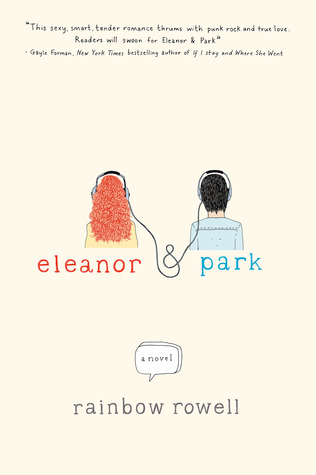
Eleanor and Park by Rainbow Rowell

Because you never forget your first love.

Set over the course of one school year in 1986, ‘Eleanor and Park’ is the story of two star-crossed misfits – smart enough to know that first love almost never lasts, but brave and desperate enough to try.  

Park is the only Korean boy (as far as he knows) in the entire of Omaha. He skates just on the edge of freakdom by an unexpected friendship (sort of) with the captain of the football team. Eleanor just doesn’t fit in – she’s big, red-headed, ungainly and lives in a house of horrors with her mother, feral stepfather and three siblings. Banished from home for a year because her stepfather can’t stand her, she’s come home and started at a new school. No-one talks to her, the mean girls steal her clothes during gym and flush them down the toilet and no-one wants to let her sit next to them on the bus..until Park relents and moves over by the window to let her sit down. In the course of the school year, they slowly discover a mutual love for comic books and music – and eventually, each other.  

Park’s family are absolutely set against Eleanor, she’s just not what his petite, plain-speaking Korean mother wants for her eldest son. Eleanor just can’t tell her family anything about it. Her stepfather rules with a rod (and fists) of iron and Eleanor knows that if he finds out that anyone is doing anything nice for her, he’s likely to beat her or worse – send her away again.  

This is a great story. It recreates the mid-80s perfectly, with the music, movies, fashion and language and paints a very, very realistic and engaging story about two unlikely lovers and the way that teenage love is sometimes all you need – but is sometimes also just more than you can cope with.
 
Di

Across The Universe by Beth Revis


Seventeen year old Amy joins her parents on a inter-galactical colonisation mission to Alpha Centauri. While her parents are essential to the future of the colony, Amy is listed in the manifest as ‘non-essential cargo’. Cryogenically frozen (and the book goes into quite uncomfortably detailed descriptions about what this might feel like), the colonists are loaded aboard ‘Godspeed’ for the 300-year voyage, with the spaceship manned by workers who, over the generations, will tend the vessel and the precious cargo.

Amy begins to awaken. Are we there yet? Embedded in her cryogenic soup, she begins to drown, but is rescued by a quick-thinking worker. But Amy’s journey is just beginning. Someone is unplugging the colonists and allowing them to die. Fifty years before the voyage is due to end, Amy finds herself stranded alone in a world that has long forgotten her and everyone and everything that she remembers – with a murderer on board. It is utterly chilling.  

Revis portrays the claustrophobic and incestuous atmosphere aboard ‘Godspeed’ extremely well and the desperation of Amy in trying to adjust to her new life. There is no grass, only something that looks like it. There is no sun, only a bright light that sort of looks a bit sunnish but not really. The food looks familiar but doesn’t taste the same. The animals look like animals back on Earth, but don’t behave like them. She wants nothing more than to unplug her parents and to have someone or something familiar to clutch hold of – but her parents are vital to the future of the colony and she needs to protect them against whoever is killing the space travellers.  

Of course, it’s also a love story. Each generation (bred at precise intervals and injected with DNA-enhancing genes to overcome the dangers of inbreeding) has a leader – Elder. Amy is so different – among an entire spaceship of people who look the same, she alone has pale skin and ‘sunset hair’. She’s a freak and is shunned, but Elder is entranced. With the help of rebels on board, Amy and Elder defy the dangerously omnipotent hierarchy to discover the secrets aboard the ‘Godspeed’ – who is killing the colonists and why, and why isn’t the ship getting any closer to its final destination.  

This is a book written for teens, but very entertaining and suspenseful. Revis creates a very realistic picture of life aboard the ship and the secrets and dangers that must be overcome.
 
Di

Tuesday, 15 January 2013

The Brilliant Women Collection by Eve Merrier


I thoroughly enjoyed reading this quirky little book by Eve Merrier.  This is a personal collection of those women who have inspired the author along with some simple facts and figures relating to the disparity between men and women in the working arena, along with a nice injection of humour in the commentary.  Eve's role models "don’t stand behind anyone: they are next to their partners as equals or they are way out ahead, showing them how it’s done.”

Those inspiring women through the ages include activists, inventors and philosophers along with well known figures such as Michelle Obama, Hillary Clinton and our very own Julia Gillard (whose popularity certainly increased after 'that speech' fired at the opposition leader Tony Abbott).

I must admit that I had not heard of many of the women within this collection, but it was certainly interesting to see how hard it has been, how far we have come and how far we have yet to go.  It got me thinking of the women who I find inspiring and amongst them I found my own sister who has battled for recognition within her field of research at an English University and who was constantly passed over for promotion in favour of (less qualified?) males.  She never gave up though and has since received the recognition she deserves.

This book could have had a heavy feminist tone, but it does not.  It is simply a celebration of those unselfish women who have forged ahead in their chosen field and raised awareness of women's issues in the process.  The consistent message in this book is: 'be yourself' and 'never give up'. 

A nice inspiring read.

Maxine

Friday, 7 December 2012

The Brothers Karamazov ~ Fyodor Dostoevsky


The Brothers Karamazov is the story of three brothers, two women, a grotesque father, an illegitimate brother and three thousand rubles, set in a provincial town in Russia in the 1860's. 

Dimitri Karamazov was my favourite of the brothers.  He is a 'scoundrel' by his own admission and whilst he has a good, if not passionate heart, he has a temper which prevents him from doing what is right.

Alexei (Alyosha) Karamazov is the type of character I find annoying.  He is too 'good' and kind, (like a benevolent Dickens character, just a bit too good to be true) but I read that Dostoevsky had lost his 3 year old son Alyosha to epilepsy, and so he imbued Alexei with the qualities he admired and, I guess, would have wished his son to have aspired to had he lived.  The author's grief at the loss of his son is also reflected in the novel with the death of a young character, whose funeral scene I will never forget.

I felt I didn't really get to know Ivan Karamazov very well, he is the serious brother who adores the youngest (Alexei) but he carries the Karamazov chip on his shoulder for all to see.

This is one mammoth read, and I did at times feel bored with some of the philosophical passages and long speeches, and I was a bit baffled by The Grand Inquisitor until I read it a couple of times and could appreciate and agree with what Ivan was saying.  But, if you can get past the religion and philosophy this is an exciting story of lust, passion, greed and murder.

I must mention too, the characterisation of the brother's father Fyodor is wonderful.  He is a middle aged wealthy pig.  He is a lustful, disgusting and rude drunk who actually made me laugh in most of his scenes.  He is so vile I loved him! ( I wonder what this says about me, I loved Fyodor but found Alexei annoying? Maybe I just appreciate well drawn antagonists?).

There is a sort of madness attributed to all the characters I have read so far by Dostoevsky, yet you can always identify with them and their self destructive natures.  This novel was planned to be part of a greater work but was sadly never realised as Dostoevsky died just four months after its publication.  I would love to have known what he had in store for Dimitri.

 Maxine