Saturday, 8 June 2013

The Making of the Tudor Dynasty ~ Ralph A Griffiths

Tudor monarchs have consistently attracted more popular and scholarly attention than any other royal dynasty in British history. The peculiar origins of the Tudor family and the improbable saga of their rise and fall and rise again in the centuries before the Battle of Bosworth have, however, received far less attention. 

Based on both published and manuscript sources from Britain and France, The Making of the Tudor Dynasty tries to set the record straight by providing the only coherent and authoritative account of the ancestors of the Tudor royal family from their beginnings in North Wales at the start of the 13th century, through royal English and French connections in the 15th century, to Henry Tudor's victory at Bosworth Field in 1485.  

This book is quoted many times in most of what I have been reading.  I guess I am becoming entrenched in Tudor History.  I have read so much recently but it all comes down to reading another one just to make sure.  Most of the authors begin with saying that nothing was recorded about this period so it is based on their investigations from the same historical evidence (minimal) as many others have used.  Then it is recorded from their own perceptions of where the participants were at any given occasion, often with the women they don't really even know that.  So getting to the actual truth about anything, (shown even by finding the remains of Richard III which was  based on centuries of knowing nothing until someone spent decades on finding the exact, spot) is probably minimal.


I thoroughly enjoyed it anyway.

Roybn S.

Friday, 31 May 2013

The Torrent ~ Amanda Gearing

For the May theme of Disasters, I read "The Torrent, Toowoomba and the Lockyer Valley, January 2011" by Amanda Gearing. 

This is a non fictional account of the terrible flooding disaster, based upon many interviews with survivors of the ordeal. It covers flooding from Spring Bluff right through to Grantham and then the rebuilding efforts.

I was so moved by how each individual did everything they could to help one another. Strangers, neighbours, everyone. It is sad, it is moving and it is gripping. I recommend it to others as a way to learn more about this ordeal. 
Bianca

Wednesday, 20 February 2013

Dr. Zhivago - by Boris Pasternak


Given a theme of romance for February, the month of Valentine’s Day, my mind immediately raced to this story. I saw the movie in the 1960s when it was first released, and was completely enthralled by the scope of the story, the wonderful chemistry between Omar Sharif, Julie Christie and Geraldine Chaplin: not only their physical beauty but their powerful acting through the ranges of intense love and joy to utter tragedy against the background of WWI and the early days of the Russian Revolution in all the blind, misguided cruelty that demanded loyalty or death of a long-repressed people.

The author, Boris Pasternak (1890-1960), poet, translator, and philosopher, suffered all of the repression that the Lenin/Stalin regimes used on non-conformist academics. ‘Dr. Zhivago’ was one of only two novels he wrote, but he had a large body of poetry, translation of classics and general academic literature, and was awarded the Nobel Prize for Literature in 1958, much to the fury of the Soviet government. The book, smuggled out and published first in Italy in 1958, was banned in Russia until the late 1980s.

I was warned that the movie is a lot better than the book; I would argue that the movie is a lot easier to digest! It seems that in this book as in other Russian writing I’ve read, the story is so multi-layered, so detailed and with so many political and social issues explored, that there is no such thing as a simple Russian story. I spent some time backtracking to trace characters and events that resurface throughout, so it is a challenging read.

That said, I loved its scope and incredibly rich descriptive language. Zhivago, a middle-class academic and medical doctor by profession, is a kind, thoughtful, distractable man, happily married to his childhood sweetheart Tonya, a teacher of similar background, sweet, devoted and politically naïve. Lara, a nurse, from a working-class background but well-educated and as pragmatic as she is beautiful. As a schoolgirl she was seduced by a middle-aged, amoral wealthy lawyer, Komarovsky, who is obsessed with her and re-enters her life throughout the book. Interestingly, while the movie depicted Lara as the victim of this affair, the book makes it clear that she was quite ambivalent about him; hating his superior power but at the same time, albeit reluctantly: “Kamarovsky’s philandering in a carriage …or in an opera box in full view of the audience pleased and challenged her by its mixture of secrecy and daring.”

Even when Lara in desperation tried to murder him, it was Komarovsky’s intervention that spared her from arrest. Pasternak shows real insight into the nature of an exploitive sexual relationship not often discussed in the 1960s. Years later, she blurts out to Zhivago:   “…I discovered life much too early, I was made to discover it…from the very worst side – a cheap, distorted version of it – through the eyes of …one of those useless, self-satisfied egoists who took advantage of everything and allowed themselves whatever they fancied.”

Lara married Pasha Antipov, a shy and intense fellow graduate who worshipped her, and they moved to the provincial Urals to teach; she loved their idyllic life and adored their baby daughter, but he felt constrained by her devotion and domesticity despite his love for her, and joined the army in the face of her frantic pleas.

All of the main characters in their own way are initially captivated and excited by the early signs of revolutionary thought and bold, hitherto unheard-of protest actions against the repression of Tsarist Russia and the futile destruction of WWI:  “…Mother Russia is on the move…The revolution broke out willy-nilly, like a breath that’s been held too long…socialism is the sea, and all these separate streams, these private, individual revolutions are flowing into it - the sea of life, of life in its own right.”

However, as they go about their lives, each of them comes to the tragic realisation that the ‘temporary discomforts and hardships’ inherent in radical change, have become cemented into an unrelenting and often fatal struggle for mere survival; that they have exchanged the pitiless repression of tsarism for the ruthless, paranoid machine of communism. Pasternak’s bleak, unsparing writing brings stark focus to the human misery and degradation of a population as countless thousands suffer and die by deliberate murder, hopeless mismanagement, starvation and exposure. Family members just disappear without any hope of tracing their fate.

Against this background, the love story of Zhivago and Lara survives as they are thrown together first in a wartime hospital, after which he returns by means of a tortuous train journey to his adoring wife and son in Moscow. Zhivago has longed for “…this coming home to your family, to yourself, this renewal of life” but becomes depressed with the relentless grind of scrounging to survive Moscow’s bitter winter, the endless arguing between tsarists and pro-revolutionaries who have seen nothing beyond their own relatively untouched city, and his attempts to be an effective doctor while disease becomes rampant. After almost dying of typhus, he takes his family to live hundreds of miles away in an old family home in Yuryatin in the Ural mountains. The description of their journey in a freight truck, and Zhivago’s unwitting confrontation with Lara’s husband (now named Strelnikov, a high-ranking revolutionary soldier) is like an extreme story of your worst journey. When they finally disembark, to “…the silence, emptiness and tidiness of the station…not to be surrounded by a milling, cursing throng “, the long-suffering Tonya sees the greenery and flowers of a birch forest, cries out ‘How lovely’ and breaks down in tears.

The family settles happily in to their home with all the hard work and help from neighbours and old acquaintances recorded in Zhivago’s diary; he has renounced medicine and is writing to his heart’s content, Tonya falls pregnant. Then, on a trip to Yuryatin’s library he meets Lara again and finds she is living in the town. This is where they both recognise their mutual love. Zhivago, torn with guilt at his adultery and resolving to end the affair forever, rides to see her – he is kidnapped on the road by a band of revolutionary soldiers and taken away to ‘serve the proletariat’ by treating their endless casualties. His family never sees him again.

Years later Zhivago and Lara are reunited and spend some time together just being lovers, happy together in the middle of the unending danger and privation of Soviet rule as the civil war against the so-called counter-revolutionary ‘White Russians’ grinds on. I think their love story is moving, both in its intensity and their honest insight into their relationship and their continuing emotional ties to their marriage partners.

Ultimately there is no happy romantic ending to the story, and all the main characters are separated into their separate tragedies – a sad but realistic result in the context of the historical context. To me though, it is still a powerful love story. Overall, I love this book as a gripping work of history with a very human, very moving interpretation that probably could only have been written by a contemporary Russian academic.  He was there.

Helen

Wednesday, 13 February 2013

Thursbitch ~ Alan Garner


I have been meaning to read Thursbitch for quite some time, but as I had read somewhere that it was difficult to read it made its way to the back of my list. When I finally got it from the library I was astonished to see that it was only 158 pages long.

I will ignore references to ‘difficult reads’ in future as I may never have bothered with this fantastic little novella.  It was wonderful, I couldn't put it down, and I wished so much that I was there in the valley of Thursbitch, which was brought to life so vividly by Garner.

There are two intersecting narratives, one set in the 18th century and another set in the present day.  At first the reader is tantalised by a mystery – in 1755 a packman by the name of John Turner is found dead in a snow storm with the print of a woman’s shoe by his side. Then we are introduced to Ian and Sal, who we believe are married, or are lovers, as they trek through Thursbitch discussing the geological formations.  We are tantalised by the names of the standing stones, the eerie atmosphere, and unexplained sights and sounds.  As the story progresses, you find yourself turning back to the first few pages to read them again and it all starts to make sense; though Ian and Sal are not what you thought they were, and the reason why they return to the valley leaves an emotional charge which is very affecting.

I loved the way this was written, the dialogue for the scenes set in the 18th Century are written in the local Cheshire dialect of the time, and the dialogue between Ian and Sal feels so natural and real it’s not like you are reading a novel at all.

Outstanding, I loved it!

Maxine

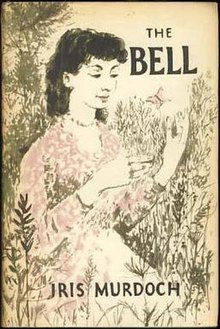
The Bell ~ Iris Murdoch


This is my third Iris Murdoch read.  I thoroughly enjoyed the satirical A Severed Head and the hilarious The Sea, The Sea, so when I picked up The Bell and read the blurb I was expecting a comedy of sorts set in a religious community.  What I got, however, was a totally different kind of read with The Bell being more about dysfunctional people, flawed relationships and torn emotions. 

The novel is set in Gloucestershire at Imber Abbey, where a small lay Anglican community live and work simplyThe story opens with Dora Greenfield, a wayward mischievous woman who is returning to her marriage after an affair.  Dora’s husband Paul, an older man, loves her but no longer respects her and though she is frightened of him and his bullying ways she is more afraid of him when they are apart.  Paul is conducting research at Imber Abbey and when Dora arrives she feels like a fish out of water as whatever she does seems to contradict with what the community is about.

The novel then switches focus to the head of the community, and owner of the Imber Community house, Michael MeadeOriginally a teacher, he once had dreams of becoming a priest but these were destroyed by his affection for a boy called Nick Fawley a student at the school where he taught, and who told all to the head of the school to Michael’s shame.

The boy becomes a troubled man; a raging alcoholic who constantly threatens suicide, and who comes to stay at the lodge located across the lake from the Imber Community house.  Nick’s twin sister Catherine is a revered member of the community as she is preparing to enter the Abby as a nun (though this appears to be against her will) and it is only for this reason that Nick and his dog Murphy are tolerated – at a distance.  A situation that is torturous for Michael.

Another main character in the novel is a student called Toby Gashe who has come for a stay at Imber before going to Oxford. Michael, during a lapse of self control, kisses Toby briefly on the lips.  The story then follows Michael’s mental torment as he questions whether he has damaged Toby in the same way that he believes he has damaged Nick.  Toby is confused and upset at first but he holds no animosity towards Michael as he genuinely likes him, but to prove to himself that he is not ‘that way inclined’ he pursues Dora.

All of this takes place during an important time at Imber – the community is awaiting the delivery of a new bell.  The old bell had a legend associated with it, and the telling of it captivates Dora’s imagination so when Toby informs Dora that whilst diving in the lake he believes he has found a large bell Dora hatches a plan.  She and Toby will raise the old bell from the lake and exchange it for the new bell thereby creating a ‘miracle’ at the unveiling.  This is a major task, but with Toby’s engineering knowledge and the help of a tractor they almost succeed……..

Dora’s character was at first charming and fun, but as the novel reaches its climax you realise that yes, one of the characters was correct when they called her a ‘bitch’.  She is very self centred, using her charms only to her own advantage, and has no regard whatsoever on how the ‘miracle’ may effect those of the community.

My favourite characterisation was that of Michael Meade and the sensitive way that Murdoch dealt with his homosexuality. Consider, this novel was written in 1958 when homosexuals were whispered about, and called ‘pansies’ or ‘queers’.  Murdoch does not write of Michaels feelings towards Nick or Toby as dirty or twisted but just as a different kind of love.  It was beautifully handled.

There is something mystical about the whole novel; it has a certain haunting atmosphere about it, the dysfunctional community members, Michael’s recurring nightmare, and the legend of that ominous bell lurking in the background.  A great read indeed.

Maxine

Tuesday, 22 January 2013

“Kenneth Branagh” by Mark White


Mark White says that he wrote the book about Kenneth Branagh ‘ to look at the way in which his work had been received, particularly the phenomenon of 'Branagh-bashing' in England. There is so much trash in our popular culture now - so many people famous for essentially doing nothing, for being good at nothing. And it seemed to me that here was someone, because he had achieved so much at an early age and had carried out an important public service in enlarging the audience interested in Shakespeare, who was in fact worth celebrating but had instead become a target for an array of rather vicious attacks. I could not understand how this state of affairs had come to exist. I wrote this book in an attempt to find out why."  

From humble beginnings in the Belfast docks, Kenneth Branagh has driven himself to dizzy heights of accomplishment. By 21 he had starred in a West End hit. At 23 he was playing Henry V for the Royal Shakespeare Company. By 26 he had established his own theatre company. Shortly after that he directed and starred in a movie version of Henry V, the start of a series of Shakespeare films that resulted in him being viewed by many as the leading interpreter of Shakespeare in the world. No actor of his generation achieved so much so rapidly.  
 
This book is a great read for Branagh fans and gives a fascinating insight into the man and his personality. It’s not paean to his greatness but a solid look at what drives him and the flaws in his character that have driven, and sometimes impeded, his career and relationships. My only criticism is its style – first he did this, then he did that - the book goes into great depth about the making of each (and every one) of Branagh’s plays and films, which can be a bit tedious.
 
Di

Don’t Look Now by Daphne Du Maurier


Am I the only person alive who didn’t know that Daphne Du Maurier wrote ‘ Don’t Look Now’ (the basis of the superlatively brilliant movie with Donald Sutherland) and ‘The Birds’ (which was turned into the great Alfred Hitchcock movie)??  

‘Don’t Look Now’ is a collection of Du Maurier’s short stories and is absolutely entrancing. It contains some of the most compelling and creepy short stories you are likely to come across. One review comments, ‘That whooshing sound you hear is your mind being sucked into the brilliant black depths of Daphne du Maurier’s Gothic imagination, the instant you begin reading the eponymous first story in Don’t Look Now….’  

The book plays on our worst nightmares – an encounter with psychic sisters and a small, dead child appearing in the streets of Venice; a strange and sinister change in the weather and the behaviour of the birds that you’ve been watching all your life; a woman emerging from eye surgery to discover that her new eyes allow her to see people as they really are – or do they?; a dalliance with a beautiful stranger offers something more sinister than the prospect of a broken heart.  

These stories show Du Maurier as an astute student of human behaviour and physchology, with a keen eye for what sends that small chill up your spine and a brilliant purveyor of the stories that keep lurking at the back of your mind long after you have put the book down.
 
Di